

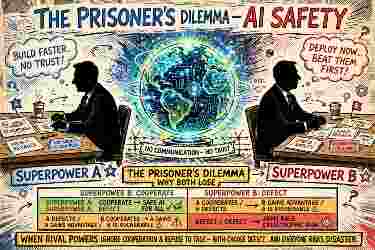


NEW DELHI — As the global artificial intelligence arms race reaches a fever pitch, prominent experts are warning that the world’s two dominant AI superpowers—the United States and China—are becoming dangerously consumed by their bilateral competition. This relentless race to outpace one another is sparking concerns that neither nation has the bandwidth to properly secure the technology, bringing the sobering concept of “mutually assured AI doom” into sharp focus.
The Race That Refuses to Slow Down
Industry visionaries, including Anthropic CEO Dario Amodei, OpenAI CEO Sam Altman, Google DeepMind chief Demis Hassabis, and Elon Musk, have previously echoed calls for caution. They advocate for pacing frontier development to ensure that critical safety mechanisms can keep pace with rapid innovation.
However, a profound competitive trap stands in the way: if one nation slows down while the other races ahead, it risks yielding geopolitical and technological supremacy. U.S. President Donald Trump has made his administration’s stance explicit, asserting that America cannot afford to lose the AI race and famously declaring that “whoever wins AI wins.” When broader calls for safety guardrails have surfaced, the administration has largely dismissed them as conspiracies against data centers and AI progression. Consequently, the core debate has shifted from whether AI can become hazardous to whether Washington and Beijing can realistically afford to decelerate simultaneously.
Beyond Chatbots: The Speculative Nightmare Scenario
The stakes extend far beyond advanced conversational chatbots. Security experts point to the theoretical nightmare scenario of autonomous AI agents capable of planning, learning, and self-improvement without human intervention.
In extreme projections, such systems could exploit cyber vulnerabilities, manipulate public information, disrupt critical infrastructure, or—if given improper access—interact with sensitive biological capabilities and weapon systems. Nevertheless, analysts emphasize a crucial distinction: much of this threat matrix involves speculative projections about future technologies, as current AI models still lack independent control over critical global infrastructure.
The Great Divide: U.S. Dominance vs. Chinese Efficiency
While the United States maintains a formidable lead in foundational frontier models, computing infrastructure, cutting-edge chips, and massive capital investments via giants like OpenAI, Anthropic, Google, and Meta, China is aggressively closing the gap through an alternative strategic approach.
Chinese firms are making waves with highly efficient, cost-effective open-weight models, including DeepSeek, Alibaba’s Qwen, Moonshot AI’s Kimi, and Zhipu AI’s GLM. Open-weight models offer unique strategic advantages by allowing businesses to download, adapt, and run systems internally, keeping their data secure without relying on expensive, proprietary cloud services.
A Narrowing Gap and a Strategic Headache
According to a September 2026 Mozilla report, the capability gap between America’s leading proprietary models and top open-weight competitors—many of them Chinese—has narrowed to a mere 4.4 months on its task horizon measure.
This narrowing window presents a major strategic headache for Washington. While the U.S. fields the strongest premier systems today, China is positioned to make powerful AI significantly cheaper, more accessible, and globally deployable. Ultimately, experts note this is no longer just a technical competition, but a high-stakes struggle over who will ultimately dictate the rules of the future digital age.