
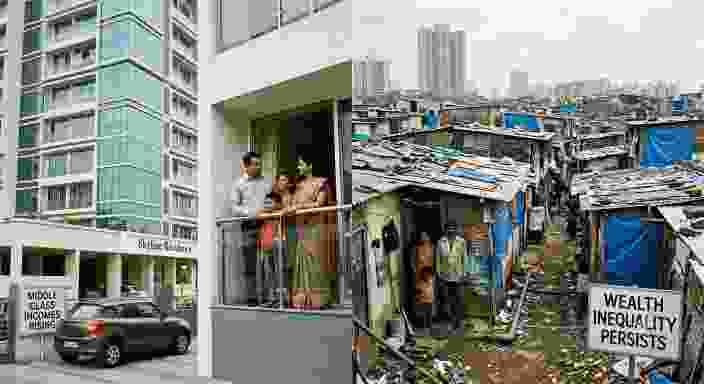



New Delhi, September 2026 — India’s economic landscape is undergoing a notable demographic and financial transformation, with millions of households climbing out of low-income categories into middle- and higher-income brackets. However, data cited in recent Red Herring Prospectuses (RHP) reveals that despite rising average earnings, wealth concentration remains heavily skewed toward the top tier, leaving even high-earning professionals struggling to afford housing in metropolitan cities.
Shifting Income Pyramids: The Rise of the Middle Class
Data highlighting India’s income distribution shows a clear upward movement away from the lowest-earning segments:
- Low-Income Decline: In FY21, India had approximately 13.5 crore households earning under ₹3 lakh annually (accounting for roughly 43% of the population). By FY26, that figure dropped to 11.9 crore households, and is projected to shrink further to 9.8 crore by FY31.
- Expanding Middle & Upper Segments: Households earning ₹8 lakh or more annually accounted for 34.38% of the population in FY26, a share projected to expand to 42.74% by FY31.
- High-Income Growth: Households with annual earnings above ₹10 lakh are expected to increase significantly from 4.6 crore in FY26 to 6.4 crore by FY31, growing their population share from 13.18% to 16.89%.
Financialization and Growing Savings Beyond Metros
The shift is not limited to higher consumption; it is also reflected in broader savings and asset ownership:
- Gross Savings: Gross household and non-profit savings reached 21.70% of GDP in FY25.
- Tier-2 and Tier-3 Growth: Financialization is expanding beyond major metropolitan centers. Assets Under Management (AUM) in mutual funds from B30 (Beyond top 30) cities nearly tripled from ₹5.36 trillion in March 2021 to nearly ₹14 trillion by March 2026.
- Asset Shift: A growing share of incremental household financial savings is shifting from traditional physical assets toward market-linked financial instruments.
The Persistent Wealth Gap and Metro Housing Crisis
Despite positive income trends, wealth distribution in India remains intensely concentrated:
- Top Concentration: Estimates indicate that the top 10% of adults (around 14.6 crore people) held approximately 65% of total wealth in 2025.
- The Metro Housing Reality: Even individuals earning ₹2 lakh a month—placing them comfortably among the top 1% to 0.5% of the population—find it extremely difficult to purchase a home in a metro city without relying on long-term loans.
Bottom Line
While ordinary household incomes are steadily rising and moving millions into higher brackets, structural wealth inequality remains a defining challenge of India’s economic growth. As the middle class expands, bridging the gap between average earnings and asset affordability in urban centers remains a critical hurdle.