



“From Spiritual Heritage to Modern Identity: Are Vedic Traditions Being Misrepresented?”
The evolution of Vedic practices, rooted in the Rigveda, the earliest known scripture of humanity, encapsulates India’s spiritual and cultural journey. From philosophical inquiry to ritualistic observance, these practices have undergone profound transformations, reflecting the sociopolitical and economic shifts of their times. However, their contemporary representation, often entangled with ideological and political agendas, raises pressing questions about authenticity and relevance.
Vedic Foundations: Science and Spirituality in Harmony
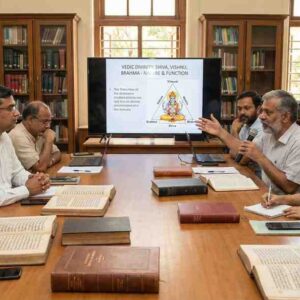
The early Vedic period (circa 1500 BCE) established practices centered on yajnas (fire sacrifices), cosmic hymns, and the pursuit of knowledge. These rituals were not limited to religious dogma; they embodied a sophisticated understanding of the natural world. For instance, theAtharvavedacontains references to medicinal herbs and early agricultural practices, providing insights into proto-scientific methodologies. The Indian Council of Historical Research (ICHR) acknowledges that these traditions influenced Ayurveda and early astronomical calculations, such as the recognition of planetary movements.
Divergence in the Medieval Era
The medieval period witnessed a transformation in Vedic practices as Bhakti (devotional) movements and the rise of temple cultures reshaped their landscape. The core Vedic emphasis on inquiry and universality began yielding to caste-based exclusivity and ritualistic orthodoxy. A study by the Anthropological Survey of India highlights the emergence of regional variations, which diluted the original egalitarian ethos of the Vedas. Commentaries like Adi Shankaracharya’sBhashyassought to revive Vedic philosophy but inadvertently reinforced social hierarchies by codifying interpretations suited to their historical context.
Colonial and Post-Colonial Adaptations
During colonial rule, Vedic traditions were marginalized, yet they also experienced reformist revival through movements like Arya Samaj and Brahmo Samaj. These movements sought to purge superstitions and reassert the rationalistic aspects of the Vedas. However, colonial ethnographers often portrayed the Vedas as antiquated texts, reinforcing orientalist stereotypes. Post-independence, initiatives like the establishment of Maharishi Sandipani Rashtriya Veda Vidya Pratishthan aimed to reclaim and preserve Vedic heritage. Census data from 2011 reveals a resurgence in simplified Vedic rituals, particularly among urbanized Indians, as part of a broader cultural reclamation.
Modern-Day Appropriations and Challenges
The contemporary revival of Vedic practices has garnered both acclaim and criticism. Government-led initiatives such as the Ministry of AYUSH’s promotion of yoga and Ayurveda have placed India at the forefront of wellness tourism. A 2023 report by the Ministry of Culture underscores a rising global interest in Vedic studies, evidenced by collaborations with international institutions. However, critics argue that selective appropriation of Vedic traditions for political or ideological purposes undermines their universality. For example, emphasizing ritualistic aspects over philosophical teachings risks reducing the Vedas to symbols of cultural nationalism.
Reviving the Spirit of the Vedas
The challenge today lies in transcending the politicization of Vedic traditions to preserve their holistic essence. Scholars emphasize that the Vedas are not mere relics but living texts capable of addressing contemporary concerns such as environmental degradation, mental health, and ethical governance. Authentic engagement with Vedic knowledge requires bridging its philosophical depth with practical application, free from ideological distortions.
The evolution of Vedic practices is a testament to India’s adaptive resilience. While debates about their representation persist, their timeless wisdom offers an enduring blueprint for harmony between humanity and the cosmos. As India charts its future, reclaiming the authentic, inclusive spirit of the Vedas remains a vital endeavor.