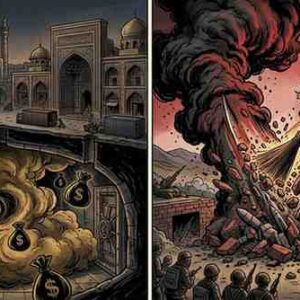
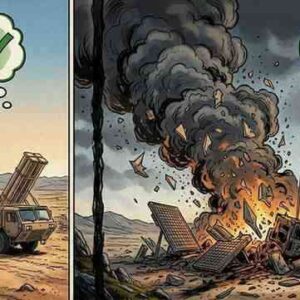

Tehran, March 2026 — Despite years of crippling Western sanctions and an economy often described as a “single-product” system reliant on oil, Iran has managed to build a massive, parallel financial world. Known as the “Shadow Economy,” this secretive network is estimated to be worth at least $200 billion, accounting for roughly 30% to 35% of the national GDP. This hidden wealth is what currently funds Iran’s extensive missile arsenal and its ongoing military confrontations across the Middle East.
Three Layers of the Shadow System
The shadow economy is not a monolith but a sophisticated three-tier structure that allows the state to bypass global restrictions:
- The Informal Sector: Approximately 70% of the workforce operates in a cash-only informal economy to survive daily life, avoiding taxation and formal records.
- Smuggling and Arbitrage: Large-scale cross-border smuggling of heavily subsidized fuel and consumer goods provides a constant stream of revenue from neighboring regions.
- The Regime Empire: The most powerful layer is controlled by the Islamic Revolutionary Guard Corps (IRGC) and Setad (the Supreme Leader’s economic network). These state-run conglomerates have acquired massive infrastructure and industrial assets over decades to generate billions in sanctioned profits.
The “Kingpin” and the Oil Laundering Playbook
A recent investigation highlighted by Bloomberg points to a secretive trader known as “Hector”—identified as Hossein Shamkhani, the son of a high-ranking advisor to the Supreme Leader—as a global kingpin of Iranian oil. Operating out of Dubai, this network uses a sophisticated “laundering playbook” to bypass sanctions:
- GPS Spoofing: Tankers turn off their tracking systems near the Strait of Hormuz to hide their location.
- Ship-to-Ship Transfers: Oil is transferred between vessels in the open sea and blended with other products to disguise its Iranian origin.
- Shell Companies and Barter: Payments are funneled through shell corporations in the UAE or through barter systems, where China provides infrastructure and military technology in exchange for crude.
A Tale of Two Irans
This shadow system has created a stark societal divide. On one side are the “Aghazadehs” (the “Gentlemen’s Sons”)—the children of the elite who live in luxury in Dubai and Western capitals, isolated from the economic collapse at home. On the other side is the “Street,” where ordinary Iranians face hyperinflation, rapid currency depreciation, and poverty.
The Sanctions Paradox
Ironically, the very sanctions designed to starve the Iranian regime have served as a catalyst for this shadow empire to flourish. By forcing trade underground, the West has inadvertently helped Iran master a secretive financial ecosystem that generates more power the darker it gets. New billionaires have been created not through innovation, but through the mastery of embargoes and shell corporations.
Bottom Line
The era of Iran’s economic isolation is an illusion; while the formal economy suffers, the shadow empire thrives. This system ensures that while the Iranian people struggle with a devalued currency, the state’s “firepower” remains fully funded through a network that the world was never supposed to see.