
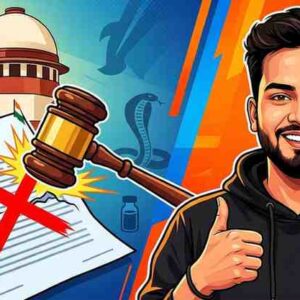


New Delhi, March 2026 — In a definitive legal breakthrough for the creator economy, the Supreme Court of India has quashed the FIR and all subsequent criminal proceedings against YouTuber and reality TV star Elvish Yadav. The ruling effectively dismantles a case that had dominated headlines and sparked intense debate over the influence of digital creators.
The court’s decision marks the end of a legal saga that began with allegations of providing snake venom for recreational use at high-profile rave parties.
The Legal Loophole: A Case Built on “Invalid Grounds”
The bench, led by Justices M.M. Sundresh and N. Kotiswar Singh, ruled that the prosecution’s foundation was structurally flawed. The court identified a critical procedural lapse: under Section 55 of the Wildlife Protection Act, a complaint must be filed by an authorized government officer.
In Yadav’s case, the charges originated from a complaint by a private NGO (People For Animals). The court noted:
- Procedural Invalidity: Private entities cannot bypass statutory requirements to initiate criminal law under the Wildlife Act.
- Double Jeopardy Concerns: The bench observed that the charges were largely based on an earlier FIR in Gurugram that had already resulted in a closure report, making the current proceedings a redundant legal exercise.
Beyond the Hype: The “Snake Venom” Illusion
For months, the narrative surrounding Yadav was fueled by sensationalist claims of “rave party syndicates.” However, the legal scrutiny revealed a different reality:
- The NDPS Flaw: While the Narcotic Drugs and Psychotropic Substances (NDPS) Act was invoked, the court found that the substances allegedly recovered did not fall under the Act’s prohibited schedules.
- Evidence vs. Optics: Much of the “evidence” circulated on social media—including videos of Yadav with snakes—was deemed insufficient to sustain a criminal trial for drug trafficking or organized crime.
“Satyamev Jayate”: The Creator Strikes Back
Minutes after the verdict, Elvish Yadav took to his platforms to signal victory. Posting the caption “Satyamev Jayate” (Truth Alone Triumphs), Yadav addressed his millions of followers, framing the case as a coordinated attempt to tarnish his reputation.
“For two years, my family and I lived under a shadow of lies. This wasn’t just a legal battle; it was a battle for my character,” Yadav stated in a follow-up video.
The creator community, often wary of legal overreach against digital stars, has largely rallied behind him, viewing the quashing as a warning against “media trials” that precede judicial facts.
The Industry Ripple Effect
The Supreme Court’s intervention sends a clear message to law enforcement and activists alike:
- Due Process is Paramount: High-profile status does not grant a license to bypass the procedural safeguards of the law.
- Influencer Vulnerability: The case highlights how easily a creator’s brand can be dismantled by allegations before a single charge is proven in court.
- The Revenue Gap: During the height of the controversy, several brands distanced themselves from Yadav. This ruling potentially paves the way for a massive commercial comeback and a “redemption arc” in the reality TV space.
Bottom Line
The “Snake Venom Case” began as a shocking expose of the dark underbelly of influencer fame but ended as a lecture on legal technicalities and procedural discipline. While the court noted that authorities could theoretically file a fresh, legally sound complaint, the current collapse of the case suggests that the “evidence” was never as potent as the headlines suggested.
For now, the masks are off: the case was less about a “venom syndicate” and more about a flawed prosecution that failed to follow the very laws it sought to uphold.