

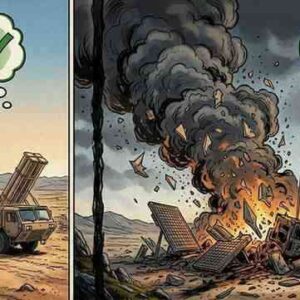

Amman, March 2026 — In a significant blow to Western air defense in the Middle East, reports indicate that Iranian forces have successfully obliterated a high-value U.S. THAAD (Terminal High Altitude Area Defense) radar system stationed at the Muwaffaq Salti Airbase in Jordan. The destruction of the AN/TPY-2 radar, often described as the “eyes” of the THAAD battery, marks a rare and high-stakes escalation in regional conflict.
The “Eyes” of the Shield: What was Lost?
The THAAD system is globally recognized as one of the most advanced ballistic missile defense shields, designed to intercept short, medium, and intermediate-range missiles during their “terminal phase”. While a full THAAD battery costs approximately $1 billion, the specialized AN/TPY-2 radar unit alone is valued at roughly **$300 million**.
Key capabilities of the destroyed radar included:
- Massive Range: Detection capabilities of 800 to 1,000 kilometers.
- High Altitude Interception: THAAD can destroy targets at an altitude of up to 150 kilometers, far surpassing the S-400 (30–40 km) and Patriot (20–30 km) systems.
- Precision Targeting: Using X-band frequency, it can distinguish between real warheads and decoys.
How Iran Pierced the Defense
While the U.S. has yet to officially confirm the extent of the damage, analysts suggest several ways Iran may have achieved this feat. The most likely scenario involves an overwhelming “drone swarm” attack using the Shahed-136 loitering munitions. By launching dozens of low-cost drones simultaneously, Iran can “overwhelm” and confuse a radar system, allowing at least one projectile to strike the target. Other possibilities include high-precision cruise missiles like the Paveh, which fly at low altitudes to evade detection.
Strategic and Psychological Impact
The loss of this radar is strategically devastating for the U.S. and its allies. Without the AN/TPY-2 radar, the entire THAAD battery is effectively blind, leaving U.S. bases and regional allies in Israel and Jordan vulnerable to subsequent missile strikes.
Furthermore, the psychological blow is profound. With only seven to eight THAAD batteries in existence worldwide—deployed in strategic hotspots like South Korea, Guam, and Japan—the loss of even one unit challenges the perceived invincibility of U.S. military technology.
Bottom Line
The destruction of the $300-million radar system is not just a financial loss; it is a tactical reset for the Middle East. By “blinding” the eyes of the regional defense shield, Iran has demonstrated a capability to penetrate the world’s most sophisticated protection layers. As the airspace over Jordan becomes more vulnerable, the U.S. faces the urgent task of reassessing its defensive posture in an increasingly volatile theater.