


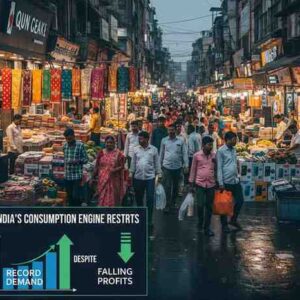

New Delhi, February 2026 —The December quarter (Q3 FY26) earnings season has concluded with a significant paradox for the Indian economy. While India’s core growth engine—domestic consumption—has finally accelerated after a prolonged lull, corporate profits have unexpectedly dipped. This divergence marks a critical “margin normalization” phase as the country adjusts to a new cost structure and recent tax reforms.
As demand returns to the streets, the corporate world is grappling with rising input costs and the end of the “easy profit” era.
The GST 2.0 Catalyst
The turning point for the consumption sector arrived in September 2025 with the implementation of GST 2.0. By restructuring tax slabs—moving electronics, textiles, and two-wheelers to 18% while shifting essentials to 5% or nil—the reform unlocked massive incremental spending power.
This policy stimulus met a ready market, resulting in 14% year-on-year volume growth for the Nifty India Consumption Index—the highest in seven quarters. In contrast, the broader India Inc. universe saw only 8% growth, proving that the current recovery is fundamentally demand-driven.
The Profit Paradox: Rising Costs
If demand is booming, why are profits down 2%? The answer lies in a “pincer movement” of rising operational expenses:
- Wage Bills: Employee costs surged by 17%, a seven-quarter high, driven by the implementation of new labor codes.
- Raw Materials: Input costs spiked by 25% year-on-year, following a 30% rise in the previous quarter.
- The High Base Effect: Profits in the festive quarter of 2024 were at a 16-quarter high due to benign input costs. Compared to that peak, 2025 appears lower as margins “normalize”.
A Fragmented Recovery
The recovery is not yet uniform across all sectors. While the “Premiumization” trend continues to boost high-end fans and kitchen appliances, other sectors show mixed results:
- Automobiles & Durables: Benefited heavily from GST cuts and festive demand. AC manufacturers even saw early pre-summer buying at discounted prices.
- Jewellers: Rising gold and silver prices boosted top lines, supported by wedding and festive demand.
- FMCG & QSR: Fast-moving consumer goods are showing “volume stabilization,” with rural demand picking up. However, Quick Service Restaurant (QSR) chains continue to struggle as mass demand is stabilizing but not yet booming.
Bottom Line
The takeaway from Q3 FY26 is that India’s consumption recovery is real in terms of volume, but corporate profits are still adjusting to a new, higher cost structure. While the demand engine has successfully restarted, the “margin cushion” provided by low inflation in previous years has faded. This may mark the bottom of earnings downgrades, but the market is still waiting for a full-scale profit acceleration cycle.