



New Delhi, India – 2025
TheNational Education Policy (NEP) 2020is revolutionizing India’s education system, challenging long-standing perceptions that sprawling campuses and extravagant infrastructure are the primary indicators of school success. Instead, the NEP places a greater emphasis onlearning outcomes, teacher quality, and skill-based education, questioning whether large facilities are still necessary for academic excellence. By shifting focus toeducational value, the NEP encourages schools to deliver high-quality learning experiences even within modest physical spaces.
The NEP’s New Priorities: Outcomes Over Infrastructure
Traditionally, large campuses, modern playgrounds, and advanced labs were seen as markers of a prestigious school. Parents often viewed these facilities as essential for their child’s success, equating size with quality. However, the NEP redefines school success by prioritizing:
- Improved Learning Outcomes: Moving away from rote learning to focus on conceptual understanding and real-world skills.
- Teacher Training and Innovation: Ensuring well-trained educators can deliver impactful learning, regardless of infrastructure.
- Technology Integration: Leveraging digital tools to enhance teaching and learning, reducing dependency on physical facilities.
- Holistic Development: Promoting cognitive, emotional, and physical growth through structured programs, rather than relying solely on outdoor spaces.
By placingeducational impactabove physical grandeur, the NEP provides a clear roadmap: a school’s success depends on thequality of its teaching and curriculum, not the scale of its campus.
Breaking the Infrastructure Myth
Studies indicate that infrastructure alone does not guarantee better learning outcomes. A recent2023 UDISE reporthighlighted that:
- 35% of rural schools lack modern infrastructure, yet many outperform better-equipped urban schools due to strong pedagogy.
- Schools in states like Kerala and Himachal Pradesh consistently rank among the best, despite operating within modest physical spaces.
This data reinforces the NEP’s message: student success is driven byeffective teaching, creative learning methods, and engaged educators—not expansive playgrounds or opulent buildings.
Technology: Redefining Space in Modern Schools
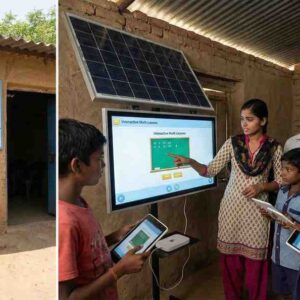
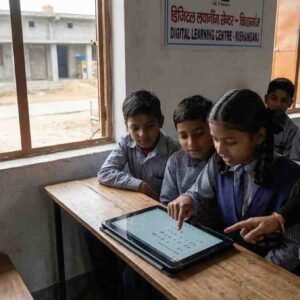
The NEP’s push fortechnology-driven educationis helping schools overcome physical space limitations. Schools with limited infrastructure are adopting innovative solutions to meet academic and extracurricular needs:
- Virtual Classrooms: Bringing quality education to students in resource-constrained environments.
- Digital Labs: Providing interactive science experiments and simulations without the need for physical labs.
- Blended Learning: Combining traditional teaching with online modules, optimizing small spaces for maximum learning impact.
For instance, rural schools inOdishaandMadhya Pradeshare using virtual science labs to teach students STEM subjects. Similarly, urban schools in crowded cities like Mumbai are transformingrooftopsandmulti-purpose classroomsinto spaces for physical education and extracurricular activities.
The Role of Facilities: Still Relevant, but Not Essential
While the NEP downplays the reliance on large facilities, it does not dismiss their importance entirely. Physical spaces like libraries, playgrounds, and labs can play a significant role in holistic development by fostering:
- Teamwork and Social Skills: Through group activities and team sports.
- Hands-On Learning: Physical science labs and art studios enable practical knowledge acquisition.
- Creativity and Free Play: Playgrounds provide spaces for unstructured, imaginative play, boosting cognitive growth.
However, the NEP emphasizes that schools can deliver these benefits throughcreative solutions:
- Indoor fitness programs like yoga, aerobics, and martial arts.
- Shared community resources such as local sports grounds and libraries.
- Technology-based alternatives to physical labs and learning zones.
This pragmatic approach ensures that schools can balanceacademic qualityandphysical well-being, even without grand infrastructure.
Global Examples: Success Beyond Facilities
Countries with top-performing education systems have demonstrated thatacademic excellence is not infrastructure-dependent:
- Finland: Prioritizes teacher quality and personalized learning over large-scale facilities.
- Singapore: Excels in global rankings by focusing on structured pedagogy and technology-driven education in compact spaces.
- Japan: Achieves high academic outcomes through discipline and innovative teaching methods, despite modest campuses.
These examples align with the NEP’s vision, proving that small, well-managed schools can outperform larger institutions throughinnovative teaching, technology, and student engagement.
The Urban-Rural Divide: A Level Playing Field
One of the NEP’s most significant contributions is its focus onequal opportunities for all schools, regardless of location or infrastructure:
- Urban Schools: Often constrained by space, urban institutions are maximizing small spaces with multi-purpose zones, rooftop activity areas, and indoor fitness programs.
- Rural Schools: While rural areas may have space, infrastructure challenges remain. The NEP promotes low-cost, high-impact solutions such as technology-enabled classrooms and community collaboration for physical education.
This approach ensures that both urban and rural schools can provide quality education without being judged by their physical size.
Conclusion: Success Measured by Impact, Not Size
TheNEP 2020sets a bold precedent, proving thatlearning outcomes, innovation, and teacher qualitydefine a school’s success—not the scale of its physical infrastructure. While facilities like playgrounds and labs remain valuable, they are no longer prerequisites for delivering world-class education.
In the NEP-driven education system, schools—big or small—have an equal opportunity to thrive by focusing on:
- Student-centric learning approaches
- Technology-driven education
- Creative use of available resources
As India embraces this new vision, it is clear thatquality education happens in classrooms full of engaged minds, not campuses defined by size. The future of education lies in impact, proving that a school doesn’t need large facilities to succeed—it needs a commitment to delivering meaningful learning experiences.