
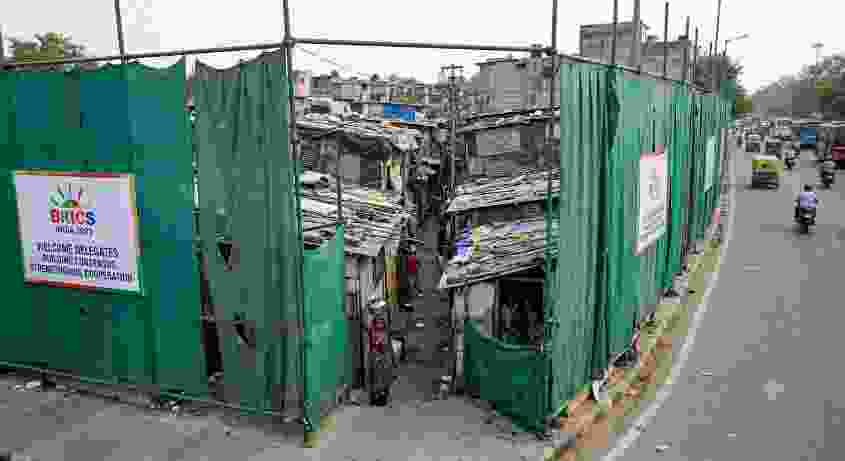

New Delhi, September 2026 — As New Delhi gears up for the high-profile BRICS Summit on September 12 and 13, the city is undergoing a rapid, albeit controversial, cosmetic makeover. Just kilometers away from luxury accommodations like the Vasant Continental, slums in the heart of Vasant Vihar have been concealed behind vast stretches of blue and white sheets.
What officials view as a necessary step for city beautification ahead of the arrival of global leaders, critics and residents describe as an attempt to sweep poverty under the rug.
Hidden from the World, Again
For the residents of the Coolie Camp in Vasant Vihar, this is not a new experience. The same blue and white sheets were erected during the G20 Summit in 2023 when the slum fell along the VIP travel routes. Now, as BRICS leaders descend upon the capital, residents once again find themselves partitioned off from the main roads.
Interviews conducted by Brut India reveal a deeply divided community. Some residents express sheer frustration, viewing the screens as an insult. “They want to hide the poor to show that our country has no poverty,” one resident remarked, pointing out the hypocrisy of masking their existence. “We clean these streets ourselves. Instead of hiding us behind curtains for days, they should fix the open drains.”
Economic Disruptions and Daily Struggles
The immediate fallout of these visual barriers is economic. For daily wage laborers, street vendors, and small shop owners living in the camps, the curtains act as a blockade. Residents report that police restricted their movement, hampering their ability to travel for work or secure daily necessities.
Shop owners directly behind the screens complained of zero footfall. “I usually make ₹1,000 to ₹1,200 a day. With this curtain covering my shop entirely, I haven’t had a single customer,” shared one vendor, adding that the four-day shutdown means eating into whatever meager savings they have.
A Section of Support
However, the sentiment is not entirely negative. Surprisingly, some residents support the move, prioritizing the nation’s image on the global stage. “If guests are coming to your home, you clean it up,” argued one long-time resident. For these individuals, the temporary inconvenience is a small price to pay to ensure foreign dignitaries do not view India as a country of “slums and garbage,” protecting the nation from perceived international embarrassment.
Bottom Line
The blue and white curtains hanging over Delhi’s slums starkly highlight the contrasting realities of hosting global summits in a developing nation. While the BRICS Summit aims to discuss massive global issues like trade and climate change—issues that directly impact these very communities—the immediate local strategy seems focused purely on optics. Whether viewed as an essential diplomatic courtesy or a harsh erasure of the working class, the curtains have once again brought Delhi’s socio-economic divide into sharp, unavoidable focus.