



“The Creator’s Journey: Understanding Brahma’s Role in Hindu Cosmology”
Brahma, the Creator in the Hindu trinity (Trimurti), holds a unique and often debated position in the vast tapestry of Hindu philosophy. Revered as the originator of the universe, Brahma is less prominently worshipped than Vishnu (the Preserver) and Shiva (the Destroyer). His depiction across Hindu sacred texts—ranging from the Vedas and Upanishads to the Puranas—offers a complex narrative of cosmic creation and its philosophical underpinnings.
Brahma in the Vedas: A Conceptual Foundation
The Vedas, regarded asshruti(divinely revealed knowledge), provide the earliest references to the process of creation, though Brahma as a personified deity is not explicitly mentioned. Instead, the Vedic hymns explore creation through abstract principles:
- Prajapati as the Creator:
- In the Rigveda, the concept of creation is linked to Prajapati (Lord of Creatures), a precursor to the later depiction of Brahma.
- The Nasadiya Sukta (Hymn of Creation) speculates on the origins of the universe, reflecting the mystical and philosophical nature of Vedic thought:
- “Who really knows? Who will proclaim it? Whence was it produced? Whence is this creation?”
- Sacrifice and Cosmic Birth:
- The Rigvedic Purusha Sukta describes the universe as emerging from the cosmic being (Purusha), whose dismemberment gives rise to the cosmos. This sacrificial act foreshadows Brahma’s creative function in later texts.
Brahma in the Puranas: The Personified Creator
In the Puranas, Brahma emerges as a distinct deity tasked with the creation of the universe. These texts provide detailed cosmological narratives:
- Emergence from Vishnu:
- The Vishnu Purana and Bhagavata Purana depict Brahma as emerging from a lotus growing from the navel of Vishnu, symbolizing the interconnectedness of creation and preservation.
- This imagery underscores Brahma’s dependence on Vishnu’s cosmic sustenance, reflecting the complementary roles within the Trimurti.
- Creation through the Vedas:
- Brahma is said to create the universe by chanting Vedic hymns, emphasizing the sacred knowledge contained in the Vedas as the blueprint for existence.
- The Brahmanda Purana (Cosmic Egg Purana) describes the universe as emerging from the cosmic egg (Brahmanda), with Brahma orchestrating its formation.
- Cycle of Creation and Dissolution:
- Brahma’s creation is not eternal but cyclical. Each day of Brahma (equivalent to 4.32 billion human years) marks the creation of a new universe, followed by its dissolution (pralaya).
Philosophical Significance of Brahma’s Role
- Creation as a Divine Function:
- Brahma represents the principle of creation, which is viewed as a divine function rather than a permanent position of supremacy.
- The Upanishads associate Brahma with Brahman (the ultimate reality), highlighting the philosophical shift from personified deities to abstract metaphysical concepts.
- Interdependence within the Trimurti:
- The Trimurti model—Brahma (Creation), Vishnu (Preservation), and Shiva (Destruction)—emphasizes the cyclical and interconnected nature of the universe.
Brahma’s Declining Worship
Despite his critical role as the Creator, Brahma is rarely worshipped in contemporary Hinduism. Explanations for this include:
- Completion of His Role: Once creation is set in motion, Brahma’s role is considered fulfilled, with Vishnu and Shiva taking precedence in maintaining and transforming the universe.
- Mythological Narratives: Stories such as Brahma’s pursuit of Saraswati (his consort or daughter, depending on the account) cast him in a morally ambiguous light, diminishing his appeal as a deity of worship.
The Brahma Temple in Pushkar, Rajasthan, remains one of the few dedicated to him, reflecting his limited presence in Hindu rituals.
Scientific and Cultural Relevance
The narratives of creation in Brahma’s depiction resonate with philosophical and scientific inquiries into the origins of the universe:
- Cosmology and Creation Myths:
- The cyclical creation-dissolution model parallels modern scientific theories like the Big Bang and cyclic cosmology, emphasizing the timeless relevance of these ancient ideas.
- Preservation of Vedic Knowledge:
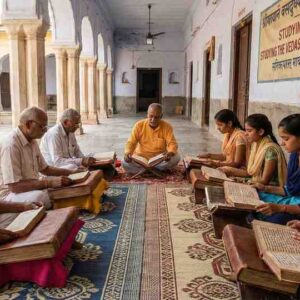
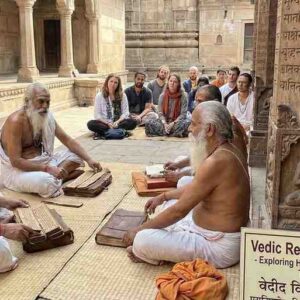
- Initiatives such as the National Manuscripts Mission and UNESCO’s recognition of Vedic chanting as Intangible Cultural Heritage highlight efforts to preserve Brahma’s association with the Vedas.
Challenges in Interpretation
- Symbolism vs. Literalism:
- Misinterpretations of Brahma’s narratives, particularly his mythological stories, risk reducing his philosophical depth to simplistic readings.
- Modern Relevance:
- As society evolves, reinterpreting Brahma’s role through a philosophical lens—emphasizing creativity, knowledge, and interdependence—can ensure his continued relevance.
Conclusion
Brahma’s depiction across sacred texts offers a profound exploration of the creative principle underlying existence. From the abstract hymns of the Vedas to the richly detailed cosmologies of the Puranas, Brahma’s role reflects the dynamic interplay between mythology, philosophy, and metaphysics. While his worship has waned, his significance as the Creator and as a symbol of knowledge and creativity endures, offering timeless lessons for understanding the universe and humanity’s place within it.
As India continues to honor its sacred traditions, studying Brahma’s role provides valuable insights into the intricate tapestry of Hindu cosmology and its enduring relevance in modern discourse.